Get in touch
Case study · Zagg

A live marketplace, and no engineering team to hire or carry. Steered by the people who knew its users.

Zagg is a reverse job marketplace for software developers. A founder who knew the market and a Cercury engineer ran it: they worked out what was worth making, shipped weekly, and changed course when the evidence said to. The factory did the building, audited at every step. The same factory is behind whatever you decide is worth making next.

See it live at zagg.app Updated daily · Audited every commit

A higher bar than most agency builds I’ve seen in fifteen years of recruiting software engineers. And those had humans in the loop charging by the hour.

Michael Cant · Co-founder, Zagg

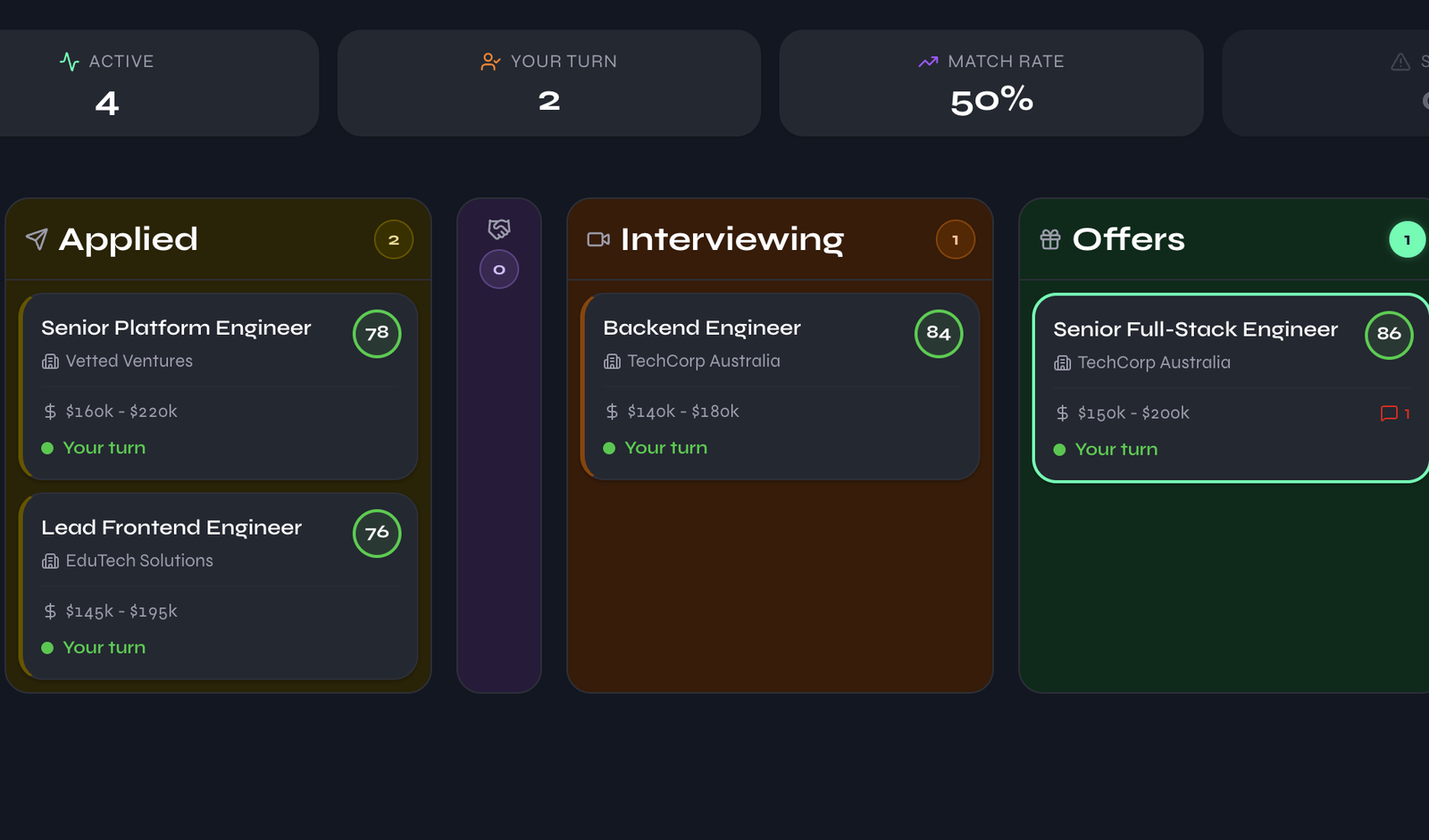
Zagg candidate pipeline: kanban board with Applied, Interviewing and Offers columns, plus active match stats
Live at zagg.app ↗
01 / The challenge

Ship a marketplace. Without hiring and running an engineering team.

Zagg's founders had a clear thesis: the job market for software developers is upside down. They wanted to flip it. The product needed a web app, an API, a design system, AI matching, federated auth, end-to-end tests, and a deploy pipeline. The traditional path was around eight engineers over fourteen months, roughly two and a quarter million dollars. They did not want that path.

Instead they ran the Cercury factory. Michael (Zagg founder) drove product, Cercury the engineering. The factory did the building, fast enough to keep pace with the calls they made.

02 / The numbers

The numbers. And what they would have cost the other way.

Four months on Cercury's factory. Or eight engineers, fourteen months, around two and a quarter million dollars. Here is the gap.

$2M+ Saved vs agency build
10 mo Faster to current depth
Fewer people on the project
334 User stories shipped
11,905 Automated tests
576 Pull requests merged

Plus 2,137 acceptance criteria · 396 React components · 263 API endpoints · 53 BDD feature files · ~10 user stories and ~32 PRs per week, sustained.

The other way: eight engineers, fourteen months, ~$2.3M. Cercury did it with two people in four.

“Two people. Four months. A live marketplace. The founders made the calls. The factory did the rest.”Vince Brouillet, Cercury & Zagg

Method. The agency counterfactual assumes a 2026 build of equivalent depth to Zagg today: around 200,000 lines of code, 396 React components, 263 API endpoints, 11,905 tests, federated auth, AI matching, design system, deploy pipeline. Eight senior engineers at roughly $250k loaded annual cost, fourteen months, $2.3 million. AI used for completion and review, not as a delivery system, consistent with DORA's 2025 finding of about a ten percent organisational productivity lift from AI adoption. Top-quartile AI adoption shifts the counterfactual to roughly six engineers, eleven months, $1.4 million. The gap to Cercury narrows but holds. Pivot speed and validation cadence compare Zagg's observed cadence against typical agency change-request cycles. Sources: DORA 2025, Marketplace MVP Cost Guide 2026, Developer Productivity Benchmarks 2026.
03 / What this changes about building product

The engineering queue is gone. Product practice changes shape.

The factory's headline metric is not lines of code. It is what stops getting in the way of shipping: the queue, the handoff, the quarter-long planning cycle, the "we'll get to it next sprint." When those drop out, the people closest to the user start driving delivery directly.

Weekly

Validate every week, not every quarter.

About ten stories shipped per week across four months. Every week is a chance to put something in front of users and learn. Validation stops being a milestone. It becomes the cadence.

Same day

Pivot the moment you decide.

Four strategic pivots in four months, absorbed without a rewrite. Redirect the factory and new work enters the next gate. No change-request. No re-quote. No resourcing meeting. Iteration cost collapses, so you actually iterate.

No queue

The bottleneck becomes your judgment, not your headcount.

Stories enter the factory the day they are written. There is no "blocked, waiting for an engineer." The constraint is how fast you can decide what to build, not how fast someone can clear a sprint backlog.

No handoff

The people close to users drive delivery.

A product owner writes the acceptance criteria. The factory builds against them. The same person who heard the customer signs off on what shipped. No translation layer, no telephone game, no scope drift between conversation and code.

This is the part you cannot buy by hiring faster. It is a different operating model for a product team.

04 / How the factory ships

Fifteen checks. Every user story. No exceptions.

Six gates, top to bottom. Seven test types fire inside one of them. Four separate reviews sit inside another. Every gate writes an artifact. Pull any user story and read the trail.

01Executable ACContract = test
02UX / UI designBefore code
03 · ×7Seven test typesType · unit · integration · contract · property · a11y · E2E
04 · ×4Four-axis reviewUX · UI · code · pyramid shape
05CI fix loopUntil green
06Coverage gateThreshold or fail
6Gates
7Test types
4Reviews
15Atomic checks per user story
05 / The evidence

11,905 tests. Stacked by purpose. Gated for shape.

Every user story passes through a pyramid-shape gate before close. Depth is not optional.

Unit · pytest + vitest9,483Integration · pytest1,732Contract + Properties405E2E2852.4%3.4%14.5%79.7%

11,905 tests · pyramid shape gated on every story · adjacent: 307 Storybook stories, Schemathesis OpenAPI fuzz

Evidence, not claims. The same scaffold behind whatever we make with you.

06 / The outcome

A live system. Not a prototype waiting to be rewritten.

Two people in the build. One drives product, one runs the engineering and the factory. The output is a marketplace you can audit at any point, evolving on a weekly cadence, with no engineering team to hire and no hours to police.

I’m not an engineer. By every conventional rule I shouldn’t be able to trust a codebase I didn’t write let alone touch one, especially one this size. I do, and the reason is boring: every story has a trail. Acceptance criteria, tests, reviews, the lot. I can pull any commit and see what was promised and what shipped against it. That’s a higher bar than most of the agency builds I’ve seen in fifteen years of recruiting software engineers. Those had humans in the loop charging by the hour. The bit that surprised me wasn’t the speed. It was finding out how much of ‘engineering judgment’ was actually just process I could now run myself.

Michael Cant · Co-founder, Zagg

We built Zagg on the factory because the alternative was hiring a small engineering team for a side product. That would have told us nothing about whether the factory works under sustained load. Four months, 334 user stories, no shortcuts at the gates. It does.

The rigor on Zagg is the rigor a client engagement inherits from day one. Same gates. Same pyramid. Same audit trail under every commit. If we stopped tomorrow, Zagg's founders would have everything they need to keep building. The same is true for any product we run through the factory.

Vince Brouillet · Founder, Cercury · Co-founder, Zagg

07 / The stack

Production scaffold, end to end.

Not a clever single-page hack. The full surface area of a marketplace product, all touched on a regular cadence by the factory.

Frontend
Next.js · React · TypeScript · Storybook design system
Backend
FastAPI · Python · PostgreSQL · Redis
AI
OpenAI GPT-4o-mini for candidate matching and de-duplication
Auth
JWT + OAuth (Google, GitHub, LinkedIn)
Testing
Playwright BDD · Vitest · pytest · Storybook
Infra & CI
Docker Compose · GitHub Actions · Terraform
The same factory. Your project next.

Zagg is one product built this way. If you have something you want to make, or you're not sure what to make yet, tell us. A 45-minute call, no pitch and no obligation. We will tell you honestly whether we are the right team for it.

Not a fit for: rebuilding legacy code, hourly billing, or work a team is already shipping on. New products and new surfaces are where we win.

hello@cercury.ai Back to the factory

We earn the next month on the work, not on the lock-in.